

Shaping the Future of Education, Business & Technology
Global Perspectives on Education, Business and Technology 2026 (GPEBT 2026)
About
Global Perspectives on Education, Business and Technology 2026 (GPEBT 2026) is an international, multidisciplinary academic conference that brings together postgraduate students, academics, researchers, educators, industry professionals, policymakers, entrepreneurs, business leaders, and technology practitioners.
The conference provides a platform for participants to present research, exchange ideas, discuss emerging challenges, and explore how developments in Business, Education, and Technology can contribute to better practice, policy, and decision-making.
GPEBT 2026 is designed to connect academic knowledge with real-world perspectives. Through research presentations, professional discussions, networking opportunities, and engagement with invited speakers, the conference encourages participants to examine current issues from multiple disciplinary and professional viewpoints.

Why GPEBT 2026?
Research increasingly crosses disciplinary and professional boundaries. Developments in digital technology influence how organisations operate, how education is delivered, how people work, and how decisions are made. At the same time, businesses, educational institutions, policymakers, and communities continue to face practical challenges that require evidence-based and interdisciplinary responses.
GPEBT 2026 creates a space where research meets practice. Participants will have opportunities to:
- present original research and receive academic and professional feedback;
- exchange knowledge across Business, Education, and Technology;
- engage with researchers, educators, industry professionals, and policymakers;
- discuss emerging issues, innovations, and practical applications;
- develop academic and professional networks;
- gain perspectives from distinguished keynote speakers; and
- explore publication opportunities for eligible conference papers.
Three Tracks. Multiple Perspectives.
GPEBT 2026 welcomes contributions across three broad conference tracks:
Business
Research and practice relating to management, entrepreneurship, economics, finance, organisational development, sustainability, marketing, digital business, and contemporary business challenges.
Education
Research addressing teaching and learning, educational leadership, curriculum, digital education, assessment, educational technology, lifelong learning, and emerging issues in education.
Technology
Research and applications involving digital transformation, artificial intelligence, information systems, computing, engineering-related technologies, cybersecurity, data analytics, and technology-driven innovation.
The multidisciplinary format encourages participants to examine how these areas increasingly intersect in contemporary organisations, institutions, and society.
Meet and Learn from Distinguished Speakers
The conference will feature distinguished speakers from academic and professional backgrounds who will share perspectives on developments shaping the future of education, business, and technology. These sessions complement the research programme by providing participants with broader insights into leadership, innovation, digital transformation, and the changing relationship between research and professional practice.
Keynote Speakers

Y. Bhg. Professor Emeritus Tan Sri Anuwar Ali
Speaker Profile
Professor Emeritus Tan Sri Anuwar Ali is one of the leading figures in Malaysian academia. He was the President/Vice-Chancellor of Open University Malaysia (OUM) and Chief Executive Officer of Multimedia Technology Enhancement Operations Sdn Bhd (METEOR), the holding company of OUM. Prior to joining OUM, he was the Director of the Higher Education Department at the Ministry of Higher Education (1995-1998) and later, moved on to become the Vice-Chancellor of Universiti Kebangsaan Malaysia (UKM).
Professor Emeritus Tan Sri Anuwar began his career as an Assistant Director at the then Ministry of Trade and Industry in 1970. Three years later, he joined UKM as a tutor at the Faculty of Economics. His career with UKM spanned over 30 years where he held various posts including the Dean of the Faculty of Economics and Deputy Vice-Chancellor before his appointment as the Director of Higher Education. Currently, he is also the Chairman of the Advisory Panel of the Malaysian Institute of Economic Research (MIER); Chairman of the Critical Agenda Projects (CAPS), National Higher Education Strategic Plan (NHESP), Ministry of Higher Education and Board Member of the Research Institute of Investment Analysts Malaysia. His previous experience include being the Chairman of the Southeast Asian Open Learning Centre (SEAMOLEC) based in Jakarta; Member of the Griffith Asia Pacific Council (GAPC) Griffith University, Australia; Board Member of the Association of Southeast Asian Institute of Higher Education Learning (ASAIHL); Chairman of the Malaysian Examinations Council; Board Member of Bank Pembangunan Malaysia (Malaysia Development Bank); Member of the Securities Commission Malaysia; Board Member of INTI University College; Board Member of SIRIM Training Services Sdn. Bhd. and Visiting Fellow, Institute of Strategic and International Studies, Malaysia. He was appointed as Economic Consultant to a number of national and international projects such as UNIDO Consultant to the Industrial Master Plan, Malaysia (1986 – 1995); UNIDO Consultant to the Industrial Development of Bhutan, 1990 – 1991; Consultant to the Action Plan for Technology Development, Malaysia and the Action Plan for Small and Medium Scale Industries, Malaysia.
Professor Emeritus Tan Sri Anuwar graduated with a BSc (Economics) degree from the Queen’s University in Belfast, Northern Ireland, in 1970. During his early years as a tutor and lecturer at UKM, he furthered his studies and obtained his masters and PhD from the University of Leicester and University of Kent, Canterbury, United Kingdom.
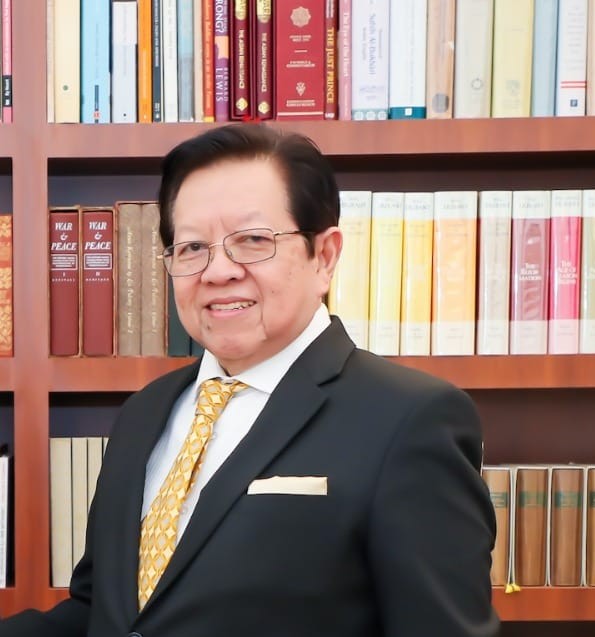
Datuk Prof. Dr. Mohd Faiz Abdullah
Speaker Profile
Datuk Prof. Dr. Mohd Faiz Abdullah is the Executive Chairman and Chief Executive of the Institute of Strategic and International Studies (ISIS) Malaysia, a leading national think tank. He plays a key role in policy development and regional diplomacy, including ASEAN-ISIS and PECC.
He serves as Malaysia’s representative to the ASEAN Regional Forum Experts and Eminent Persons (ARF EEP), Co-Chair of CSCAP, and a member of the World Economic Forum’s Global Future Council on Good Governance.
Prof. Faiz is also a Distinguished Adjunct Professor at IIUM and holds academic roles at the University of Malaya and Universiti Selangor. His career spans law, education, media, and strategic advisory, with over three decades of legal and policy experience.
He is the author of several books on geopolitics, governance, and reform, including Strategic Shift: Preparing Malaysia for a Turbulent Future.

Y.M. Academician Datuk Dr. Tengku Mohd Azzman Shariffadeen
Speaker Profile
Tengku Mohd Azzman Shariffadeen graduated from the University of Manchester with a bachelor’s degree in electrical engineering, and masters and doctoral degrees in control systems. He first served as an academic at the Faculty of Engineering, University of Malaya, for eleven years. For the next twenty-one years he was the founding Director General and CEO of the Malaysian Institute of Microelectronic Systems (MIMOS).
He led significant strategic national efforts in R&D and capacity building focused on ICT and microelectronics. As CEO of MIMOS he also served for nine years as the ex-officio Secretary of the National Information Technology Council, chaired by the Prime Minister of Malaysia. In this capacity he was instrumental in the formulation and implementation of national ICT policies and strategies, in particular, the Multimedia Super Corridor (MSC) and the National IT Agenda (NITA).
He is currently active in sharing his experience in knowledge and innovation for development, particularly in his home country Malaysia and in projects in the Middle-East and the Asia Pacific Region. He is a Senior Fellow and Vice President, Academy of Sciences, Malaysia; Adjunct Professor, International Islamic University, Malaysia; and Member, New Club of Paris. He is a member of the Board of Directors, Pernec Corporation Berhad, a Malaysian IT company.
Organising Committee
Conference Advisors
- Prof. Dr Amer Hamzah Jantan (Vice Chancellor, Veritas University College - Veritas)
- Assoc. Prof. Dr Nor Azlinah Md Lazam (Deputy Vice Chancellor, University Malaysia of Computer Science & Engineering – UNIMY)
Conference Co-Chairs
- Assoc. Prof. Dr Norizah Mohamad (UNIMY)
- Dr Anahita Ghanad (Veritas)
Technical Committee / Secretariat
- Mithila Narendran (BAC Education)
- Komalavasan (BAC Education)
- Zanurul Huzaima Zainudin (UNIMY)
- Osama Al Assme (UNIMY)
Editorial Board
- Prof Dr Habibollah Haron (UNIMY) — Chief
- Prof Dr Nor Adnan Yahaya (UNIMY)
- Prof Ts Dr Salwani Mohd Daud
- Assoc. Prof. Dr Rodina Ahmad (UNIMY)
- Assoc. Prof. Ir Dr Chin Jeng Feng (Universiti Sains Malaysia)
- Dr Alaa Salahuddin Araibi (University of Baghdad)
- Dr Fazlin Ali (Universiti Putra Malaysia)
- Dr Goh Wei Wei (Taylor's University)
- Dr Maniyarasi Gowindasamy (UNIMY)
- Dr Mohamad Shaiful Ashrul Ishak (Universiti Malaysia Perlis)
- Dr Mukunda Kumar (Veritas)
- Dr Pourya Nickfard (UNIMY)
- Dr Reazul Islam (AlBukhari International University)
- Dr Rodney Toh (Veritas)
- Ts Dr Syahril Anuar Idris (UNIMY)
- Dr Sutha Devaraj (Perdana University)
- Dr Venkata Venugopal Rao (Veritas)
- Dr Vincent Wee Eng Kim (Universiti Tun Abdul Razak)
- Dr Yulita Hanum P Iskandar (Universiti Sains Malaysia)
Tentative Programme
The conference programme is designed to combine keynote perspectives, multidisciplinary discussion, research presentations, and networking opportunities throughout the day.
Presentation Format
Each presenter will be allocated approximately 10 minutes for presentation and 5 minutes for Q&A.
The programme is tentative and may be adjusted by the conference organising committee where necessary.
Publication Opportunities
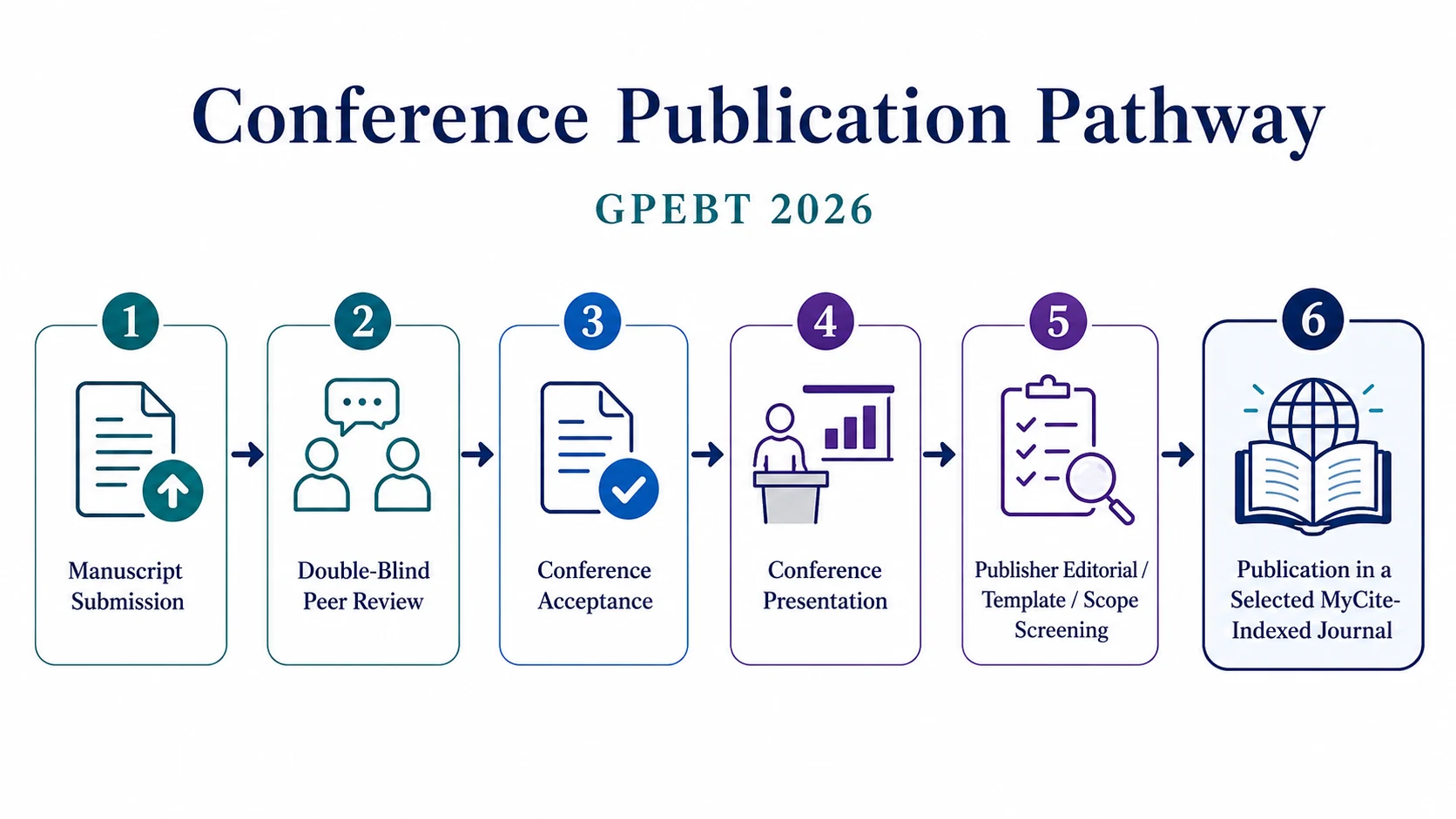
All accepted papers will undergo peer-review assessment and are eligible for publication in selected MyCite-indexed journals and conference proceedings, subject to the quality, scope, and final approval of the respective editorial boards and publishers.
Who Should Participate?
GPEBT 2026 welcomes participants from Malaysia and the international academic and professional community, including:
- postgraduate students;
- academics and researchers;
- educators and educational leaders;
- industry professionals and practitioners;
- policymakers;
- business leaders and entrepreneurs;
- technology and innovation professionals; and
- individuals interested in research, innovation, and interdisciplinary knowledge exchange.
Whether attending to present research, discovering new ideas, building professional networks, exploring publication opportunities, or engaging with current developments, GPEBT 2026 provides a focused environment for meaningful academic and professional exchange.
Important Dates
Participation Categories
Presenter
For participants submitting a manuscript for presentation and publication.
Participant
For participants and co-authors attending without submitting a manuscript.
Conference Fees
Participant (including non-presenting co-authors)
Fee: RM50
Presenter (BAC Education)
Eligible: BAC Education students and staff
(must use BAC official email for registration)
Fee: RM350
Presenter (Others)
Fee: RM450 / USD130
Currency
RM: Ringgit Malaysia
USD: United States Dollar
Publication Pathway
The conference publication pathway:
How to Submit Your Manuscript
- Prepare your manuscript using the official GPEBT 2026 Full Paper Template. The recommended length depends on the paper type.
- Create an account and log in to the official GPEBT 2026 online submission portal at https://submit.gpebt.bac.edu.my/login. Manuscripts must be submitted online through the portal only.
- Complete the submission details in the portal, including the paper title, abstract, keywords, author and co-author information, institutional affiliation, and relevant conference track. The portal will manage the author information required for the double-blind peer-review process.
- Upload your manuscript in one of the accepted formats: PDF, DOC or DOCX. Review all information and uploaded files carefully, then click Submit/Confirm Submission. A confirmation and manuscript ID will be issued after successful submission.
- Submit by 31 October 2026. After peer review, authors will be informed of the outcome. Where revisions are required, the revised manuscript must be uploaded through the same portal. Conference registration and payment are required only after the manuscript has been accepted.
Connect. Innovate. Lead.
Join GPEBT 2026 and contribute to the conversations shaping the future of Education, Business and Technology
Contact
For enquiries regarding paper submission, formatting requirements, the review process, or technical assistance, please contact the GPEBT 2026 Secretariat.
Email: [email protected]